CPEC (The
China-Pakistan Economic Corridor)
Faiza Rehman Khan
Introduction
 Year in year out Pakistan and China are in strong economic and bilateral ties that enhanced the level of cooperation between the
two countries. Pakistan has become China’s major trading partner in import as
well as exports. The commercial bonds between the two have got to develop since
2006 after the signing of Free Trade Agreement (FTA).
Year in year out Pakistan and China are in strong economic and bilateral ties that enhanced the level of cooperation between the
two countries. Pakistan has become China’s major trading partner in import as
well as exports. The commercial bonds between the two have got to develop since
2006 after the signing of Free Trade Agreement (FTA).
According to Pakistan Economic Survey 2013-2014, The
trade between China and Pakistan increased to US Dollar 9.2 billion fin 2012-13
from USD 4.1 billion in 2006-07. On the
other hand China’s export to Pak increased by one percent during the same
period. Resultantly, China’s share in export increased to 10 percent during
2013-14 CPEC is envisaged as a key to strengthening of
economic and trade cooperation between China and Pakistan. Pakistan has proved
much interest after the Li Keqiang’s emphasis on constructing the CPEC on his
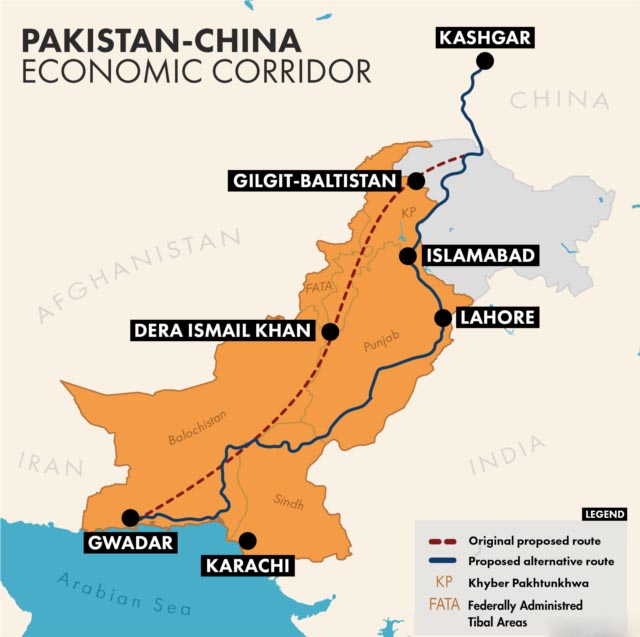
visit to Pakistan in May 2013. The corridor is going to connect Kashgar in
China to Gwadar Port in Balochistan making Gwadar fully functional deep-sea
commercial port. The port will serve China to trade between China and Africa
and Middle East. The corridor will cut the distance of 12000 kilometers that
oil supplies from East now takes to get to Chinese port.
According to China
Daily, the CPEC will benefit South Asia to maintain economic integration and
regional stability thus making it a ‘comprehensive development program’. Physical infrastructure to be built are
2,700-kilometre highway from Kashgar to Gwadar via Khunjrab, for freight railways
links between Gwadar and Khunjrab linking China and regional connectivity with Iran,
Afghanistan and India, and the Karachi-Lahore motorway. The project will also
undertake the revival and extension of the Karakorum road that connects
Xinjiang with Pakistan's Gilgit–Baltistan and KPK. The CPEC, apart from links,
the project envisions many economic zones, fast-track Energy implementation of
power projects viz a viz CPEC, producing 21,690 with the assistance of China. Baloch nationalists are of the view that such
mega projects in Balochistan are not giving a ‘due share’ to Balochis which may
arise as a major threat in future to either party of the bilateral project.
Geography of the CPEC
The CPEC is a huge project that will
undertake the construction of highway and railway links running through most of
Pakistan starting from Gwadar in Balochistan and culminating in Kashgar in
western China, while passing through parts of Balochistan, Sindh, Punjab,
Khyber Pakhtunkhwa provinces and Gilgit-Baltistan in northern Pakistan to reach
the Khunjrab Pass and beyond to China.
Eastern alignment: Pakistan and China have decided to
initially construct the eastern alignment of the corridor mainly due to two
reasons: first, Chinese companies are reportedly willing to undertake the
construction of the eastern alignment on a BOT (build-operate-transfer) basis,
and secondly it is more secure compared to the western alignment planned
earlier. The eastern alignment will run through only a few areas of Balochistan
and KP province where the security situation is more volatile compared to
other parts of the country. This change in original planning earned some
criticism from parliamentarians in these two provinces who thought the new
alignment will deprive their respective provinces of development and employment
opportunities that the CPEC brings (The News, 2014).
Senators from KP
and Balochistan during a meeting of the Senate Standing Committee on Finance
held in June 2014 said that the new corridor alignment [eastern] excluded many
areas of their provinces and the new route largely passed through the Punjab
(Ibid). The Federal Minister for Planning and Development, Ahsan Iqbal informed
the senators that investors were unwilling to construct the western route on a
BOT basis. He said the government had decided to construct the relatively more
secure eastern route first with Chinese assistance and that it had not
abandoned the original western route, which would be constructed later
Politics and Economy
China is regarded as an “all-weather
friend” and the history authenticated it as well, yet there are some variables
that may influence Pakistan’s economic and political response capacity and to
implement larger CPEC-project over longer time period. The major variables are:
1) Pakistan’s political stability and
policy consistency;
2) The present situation of
Pakistan’s economy and future scenarios.
Taking the farmer variable, consensus
of all parties of the construction and the route of CPEC is the most positive
aspect. Pakistan’s military establishment also considers China as the most
trusted partner.
Pakistan and China have also some
common geo-strategic and bilateral interests. Resultantly, almost all the factors
and dimensions suggest that the project may not halt even with the change or
shift in government or any political circumstances of a country with unstable
political system.
The change of route may emerge as a
political or geo-political issue in Pakistan but the government has vowed that
they will construct the original western route after a certain time also.
The bigger good-news is that a first
democratic shift of power has been made successfully recently and democracy is
being strengthened, which is very necessary for such long term and mega
projects.
The government allocated Rs73 billions
for the Public Sector Development Program (PSDP) to undertake projects under
CPEC during the ongoing fiscal year to be spent on the Lahore-Karachi motorway and
for land acquisition and link roads.
The estimated funds/loans required
for Pakistan being USD 32 billion are mainly to come from Chinese banks and
institutions, for that federal ministers and central government have made
several visits and accomplished the work out.
The corridor is largely expected to
be built on BOT (build-operate-transfer) basis. The cost-benefit analysis
suggests that the project will give sufficient returns over the investment. The
government may also support in the form of provision of the land.
Geostrategic
China put this great effort to
strengthen its connectivity with the various regions of the world. In 2013,
Chinese President Xi Jinping stressed to reviving the old trade routes
connecting Central Asia, China and Europe by developing 3 major corridors
through central, southern and northern Xinjiang, which connect Russia, Europe and Pakistan to China. The Chinese
have focused on the Bangladesh-China-Myanmar-India corridor that provides landlocked
Yunnan-province access to the Bay of Bengal.
China’s
focus in constructing this seems to strengthen her economic and trade
connectivity with in the region and the beyond, to meet its energy needs and
enhance export market access, it Pakistan is expected to arise trade hub in
South Asia.
Gwadar is the central place in the
new trade route of the region/s as without the functional Gwadar Port, it is
hard for China to see the corridor as an ‘energy corridor’ that is one of her
main objectives underlying the CPEC. Being near the Strait of Hormuz, channeling
about ‘one third of the world's oil trade’, Gwadar is a key to ensuring energy
security of China as it serves as far shorter route than the current 12,900km
route: the Persian Gulf through the Strait of Malacca -China's eastern
seashore.
It is envisaged that Gwadar will make
Pakistan and China stand on the advantageous strategic positions across Arabian
Sea compounding concerns of India stemming from China’s involvements on the
ports of the region such as Myanmar and Chittagong, Hambantota in Sri Lanka and
in Bangladesh’. One the other part, India being energy hungry looking forward
to develop Chabahar Port in Iran. In 2014, Narendra Modi’s cabinet have decided
to develop Chabahar Port in Iran, which is believed to have central place for
India to open a route to Afghanistan, with whom India has made very intimate
security ties and economic interests (Dawn, 2014a), and to have access
to energy-rich Central Asian States.
While Gwadar is located in
Balochistan in Pakistan, where a nationalist movements and insurgency is going
on.
Mainly Pakistan, India and Iran, engaged in proxy
wars the projects could be more about internal security for Pakistan, Iran and
Afghanistan which could jeopardize development projects in these countries.
Iran holds concerns for Jundullah (sectarian group), Pakistan holds concerns
over India’s involvement in Balochistan unrest. China has ostensibly developed
a proactive foreign policy: using UN as a platform to negate the war ongoing in
the South Asia. China also wishes to resolve the Iran’s nukes issue. On this point, for China, geostrategic
position of Pakistan is vital to make the China Pak Economic Corridor.
Moreover, in ties between India and Pakistan,
China has got to play its part. For China, at the same time, geo-strategic
position of Pakistan is very crucial. It serves as vista into the Middle East.,
Meanwhile, it already has expanded its infrastructure, trade, and energy linkages
with the most of Central Asian Republicans. But instability and instability in
Afghanistan are a major concern not only for China but also for other countries
including India, Pakistan and Iran. China is the biggest investor in
Afghanistan with around $7.5 billion. China has escalated trilateral and bilateral efforts
to strengthening regional coordination and cooperation. It hosted the Fourth
Ministerial Conference of the Heart of Asia-Istanbul Process Beijing on October
31, 2014 with a view to promote security and stability in the Afghanistan, in
cooperation with its neighbors (Arif, 2014). China has also pushed the matter
of Afghanistan’s future after the drawdown withdrawal to the top of the
Shanghai Cooperation Organization’s agenda.
Security
There are security threats linked to
the Pakistan-China Economic Corridor and might originate in Pakistan, the
Xinjiang province in China is also under security threats by the East Turkestan
Islamic Movement (ETIM) and Uighur militants. ETIM and Uighur militants have
sought shelter in tribal areas of Pakistan.
Pakistan’s security forces are fighting with foreign militants in North
Waziristan Agency including ETIM and Uighurs in recent months with the
commencement of the military operation Zarb-e-Azb which was inevitable
to make the mega project a success. militant groups and their fighters
along and across their borders.
Sindh
In Karachi, Threat level is medium however
probability of militant attack Is always there in Karachi and low in interior Sindh.
With the presence of large numbers of sectarian extremists, militant and
criminal traces in Karachi, there is a probability of attacks.
hBetween 2007-2014, 962 terrorist attacks have taken place in areas of Sindh through which the CPEC and
Karachi-Lahore Motorway will run. Most of these attacks, 889, occurred in
Karachi alone. Among 31 attacks reported form Hyderabad, most were low
intensity attacks carried out by Sindhi nationalists and others.
Most of these attacks targeted
security forces and law enforcement agencies, civilians, Shia and Sunni
religious communities, and political leaders and workers. A few attacks also
targeted NATO supply vehicles. A considerable number of low intensity attacks
also hit railway tracks and trains, mainly in interior parts of Sindh.
Punjab and Federal
According to the study of Pak Institute for Peace Studies’ (PIPS)
database on conflict and security
The overall threat level is low in
those parts of Punjab and Islamabad from where the CPEC will pass.
However sporadic incidents of violence including against the project-related
targets such as sites, engineers, workers and security personnel cannot be
ruled out completely. It is imperative to eliminate TTP’s support structures in
Punjab to prevent high value and high intensity attacks in future.
Over the past eight years, starting
from 2007, Lahore and Islamabad-Rawalpindi have faced maximum terrorist attacks
and casualties compared to other regions of Punjab through which the
CPEC-linked roads and railway links will pass.
Khyber Pakhtunkhwa and AJK10
The threat level in KPK and AJK is
also low, hazara division is more safer while Mansehra is a bit under threat.
As
mentioned earlier, local Taliban militants in Mansehra, some of them linked
with the TTP, can pose a degree of threat to workers and engineers with the
CPEC, but the probability and intensity of such a threat is low.
Gilgit
Past of Gilgit is pregnant with
sectarian strife. TTP existence and attacks on security forces are also
revealed in the area. However, the support structure and militant bases are
absence in the area, so the risk level is low here. However, sporadic attacks
on the CPEC-linked sites and personnel cannot be ruled out.
State’s capacity and law & Order
Situation
Pakistan has the required capacity
and security infrastructure to deal with potential threats to the CPEC project.
The country has a huge security and law enforcement infrastructure comprising
military, paramilitary including Rangers and FC, police and local police forces
such as the Khasadar force in FATA and Levies force in Balochistan.
Additionally, it has strong professional intelligence agencies. Sufficient
sources and equipment for security, law enforcement and intelligence agencies
would imply better standard. But with the threat of terrorism being
non-conventional and asymmetrical, Pakistan needs more stringent efforts to
deal with this threat.
Tribal militants against whom the
Pakistani army has launched several military operations in the past, including
latest military operation, Zarb-e-Azb – launched on June 15, 2014 in
North Waziristan that is ongoing –would suggest a policy of containment of
militancy, but much needs to be done in this regard. Initial reports following
the launch of the military operation in North Waziristan suggested that foreign
militants mainly those from Central Asia and China were prime target of
military strikes. Several militants belonging to ETIM and the Islamic Movement
of Uzbekistan (IMU)–both groups along with the TTP have close links with
Chinese Uyghur militants–have been killed in the military operation so far. The
government and army have vowed to clear North Waziristan of all militants
including local and foreign, so there is hope that these foreign militants from
Central Asia and China will no more find sanctuaries and shelter. Some reports
suggest many of them have already relocated to either Afghanistan and elsewhere
or other parts of FATA and Pakistan. However, it has been established that many
of their ‘hideouts’ in Waziristan have been destroyed. This will certainly
reduce security threats for the CPEC project emanating from FATA.
As far as Balochistan is concerned,
the province is already under strict security scrutiny in the presence of the
Frontier Constabulary, police and Levies. In recent months, attacks by
nationalist insurgents and militants have decreased. The state’s security
apparatus in Balochistan, if utilized effectively, is capable to deter any
threats to CPEC-linked projects and activities.
However, there is an immediate need
to address security problems in Karachi, which is complex city where militants
find many weak spots and spaces to hide, recuperate, recruit, plan and operate.
The Rangers and police have carried out security operations in the city, but
there is need to expand scope of this operation to eliminate all sorts of
militants.
Law enforcement agencies, mainly the
police can handle the security of the CPEC alignment in Punjab, Islamabad, KP
and also Gilgit-Baltistan with the help of intelligence agencies. Coordination
among different security, law enforcement and intelligence agencies will be
vital to secure the route, construction and workers of the CPEC project.
Provincial police departments can
take pre-emptive steps to ensure the security of Chinese engineers and others
working on the CPEC-related projects. Some precedents were set in recent past.
For instance, the Lahore City Police established eight special security desks
around the city in June 2014for Chinese citizens employed in government,
semi-government and private sectors (Express Tribune, 2014).
4. Conclusion
Sustainable
political stability in crucial to implement the mega projects like CPEC.
Throughout the course of its history Pakistan has been undergoing the one after
the other turmoil that hindered the sustainable development initiatives.
Democratization and anti-terroristic planning and implementation, National
Action Plan are vital to way forward. South Asia over all and Pakistan more
specifically need peace to survive the competitive world and economic markets.
Export markets are changing their dynamics. World economy need visionary
outlook and leadership. China and Pakistan jointly have planned and
implementing the project by implementing the vision 2025.
 Although the prevailing environment
of insecurity, militancy and violence in Pakistan can pose serious threats to
the construction of the China-Pakistan Economic Corridor, the level and nature
of this threat is not uniform across Pakistan. It is encouraging that the areas
through which the finalized eastern alignment of the corridor will run are
relatively more secure than those of the earlier planned western alignment,
though with few exceptions. The level of threat to the security of the CPEC
project, including sites and personnel, is low along most areas of eastern
alignment with the exceptions of Gwadar, the Makran Coastal Belt and Karachi,
where threat level is assessed to be medium. At the same time, it is imperative
to ensure stringent security measures along the entire CPEC alignment
Although the prevailing environment
of insecurity, militancy and violence in Pakistan can pose serious threats to
the construction of the China-Pakistan Economic Corridor, the level and nature
of this threat is not uniform across Pakistan. It is encouraging that the areas
through which the finalized eastern alignment of the corridor will run are
relatively more secure than those of the earlier planned western alignment,
though with few exceptions. The level of threat to the security of the CPEC
project, including sites and personnel, is low along most areas of eastern
alignment with the exceptions of Gwadar, the Makran Coastal Belt and Karachi,
where threat level is assessed to be medium. At the same time, it is imperative
to ensure stringent security measures along the entire CPEC alignment